
Every port call generates a DA containing a detailed breakdown of costs such as pilotage, towage, berth fees, agency services, terminal operations, and a range of additional charges. For companies managing hundreds or thousands of port calls each year, this represents a continuous and substantial financial flow within their broader shipping operations.
On paper, the process appears straightforward: costs are quoted, services are delivered, invoices are submitted, and accounts are settled. In practice, the level of precision required to fully validate those costs is difficult to maintain at scale, especially in environments where port call management is still supported by fragmented tools rather than a dedicated port call management software or integrated maritime operations platform.
Across the industry, a small but persistent pattern emerges in the form of minor discrepancies, inconsistencies, and unverified charges that accumulate over time. Individually, these differences are rarely significant enough to trigger concern. In aggregate, they form a structural source of margin erosion that often remains under the radar.
This is frequently described as “just a few percent,” yet even a deviation of one to three percent can translate into substantial financial impact when applied across large volumes of port calls.
The part no one really sees
Financial leakage in port operations rarely presents itself in a visible or disruptive way. There are no operational delays or immediate consequences that force attention. Instead, it exists within the detail of invoices and supporting documentation, where small deviations can easily pass unnoticed in high-volume environments.
A tariff may be slightly higher than agreed, a service line could be duplicated, or an additional charge might be included without sufficient justification. Supporting documentation is not always complete, and follow-up is not always proportionate to the perceived impact of the discrepancy.
Michiel Somford, co-founder responsible for finance and legal at Beacon52, explains:
“No single invoice explains the problem. It’s the accumulation. Small deviations become part of the baseline, and over time that baseline drifts.”
Because these deviations are embedded in day-to-day processes, they are often treated as an unavoidable aspect of complex global operations rather than a structural issue that can be addressed. This is particularly true in organisations where disbursement account management still relies on manual workflows instead of structured DA management software.
When volume turns detail into risk
The scale at which Disbursement Accounts are processed amplifies this challenge. A single port call can include dozens of individual cost items, each of which requires validation against tariffs, contracts, and operational context.
For operators managing large fleets, this results in a continuous stream of financial data that must be reviewed, often within limited timeframes. In many organisations, this process remains largely manual, relying on line-by-line checks, email communication with agents, and fragmented documentation instead of structured shipping workflow software or a dedicated port call system.
While this approach can be effective at smaller scale, it becomes increasingly difficult to sustain as volumes grow. The ability to validate every detail consistently diminishes, and teams are forced to prioritise based on perceived risk rather than complete verification.
Gep Navest, co-founder responsible for commercial and operational strategy, describes this dynamic:
“At some point, the volume simply outpaces the ability to verify everything in detail. Teams focus on what stands out. The rest is processed on trust.”
Under these conditions, financial leakage is not the result of isolated errors, but the natural outcome of a system that is not designed to maintain full control at scale.
The missing link between operations and finance
A key factor underlying DA leakage is the disconnect between operational execution and financial validation. Port call activities are managed in real time by operations teams coordinating agents, terminals, and vessels, while financial review takes place afterward, often with limited access to the full operational context.
This separation makes it difficult to assess whether certain costs were justified. Additional services, waiting times, or deviations from the plan may be valid, but without a reliable and shared record of events, validation becomes dependent on interpretation rather than verification.
Mico Milojevic, co-founder responsible for technology at Beacon52, highlights the structural nature of this issue:
“Financial control depends on operational truth. If you don’t capture what actually happened during a port call, you can’t fully validate the cost of it.”
As a result, finance teams frequently rely on incomplete information, historical assumptions, or trust in external parties, rather than on a fully transparent and verifiable dataset. This is where the gap between operations and finance becomes visible, especially in organisations lacking an integrated maritime operations software environment.
The real impact of small percentages
In isolation, a discrepancy of a few percent may appear manageable. In the context of port-related expenses, which can account for up to 40–50 percent of total voyage costs, the cumulative effect becomes significant.
For operators handling large numbers of port calls each year, this is not a one-time issue but a continuous financial drain. It directly affects voyage margins, reduces predictability in cost management, and complicates accurate performance analysis across fleets and regions.
Beyond the measurable financial impact, it also introduces a degree of uncertainty into the organisation. When costs cannot be fully validated with confidence, it becomes more difficult for teams to rely on the data that underpins operational and financial decision-making.
The hidden workload behind financial control
Managing Disbursement Accounts under these conditions requires considerable effort from both finance and operations teams. Discrepancies must be investigated, agents contacted, and supporting documentation requested and reviewed. Internal alignment is often needed to reconstruct the context of specific charges.
For organisations operating with lean teams, this creates a sustained administrative burden that is difficult to reduce without structural changes to the process. Even when the work is completed, a degree of uncertainty often remains due to the fragmented nature of the information available.
Many professionals recognise this pattern as a normal part of their daily work: processes function, invoices are processed, and payments are made, but full confidence in the outcome is not always achieved.
From checking invoices to controlling the process
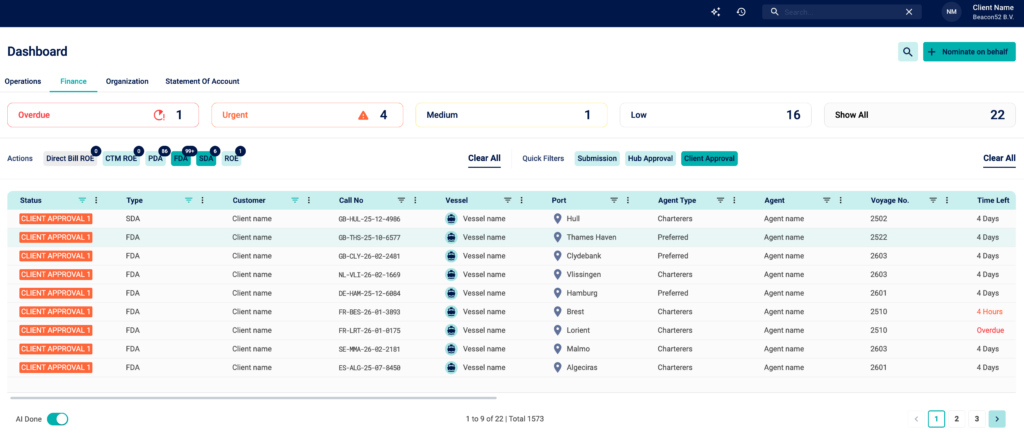
A shift is emerging among operators who are seeking to improve financial control without increasing manual workload. Rather than treating validation as a separate, post-event activity, they are integrating financial oversight directly into the operational workflow of the port call.
By capturing operational events, service confirmations, and financial data within a single structured environment, the context required for validation becomes immediately available. This is typically enabled by a modern port operations platform or port cost management software that connects operational workflows with financial oversight.
Costs can then be assessed in relation to what actually occurred, rather than reconstructed after the fact.
This approach changes the nature of the process. Validation becomes continuous instead of reactive, discrepancies can be identified earlier, and reliance on manual follow-up is reduced. The focus moves away from checking individual invoices towards maintaining control over the process that generates them.
Financial integrity as a competitive advantage
Shipping will always involve complexity. Port costs vary across regions, local practices differ, and Disbursement Accounts remain detailed by nature. That complexity, however, does not have to result in structural financial leakage.
Companies that successfully address this challenge do so by creating transparency across both operational and financial domains. By connecting execution with validation and introducing structured workflows, they reduce dependence on assumptions and improve the reliability of their data.
In this context, financial control becomes an integral part of how the business is managed. It enables consistent margin protection, supports audit-ready processes without adding unnecessary friction, and allows teams to operate with confidence in the accuracy of their numbers. Organisations that adopt dedicated disbursement account software or broader maritime cost control software are typically better positioned to achieve this level of control.
In an industry where margins are under constant pressure, reducing even a small percentage of leakage represents a meaningful and structural improvement in operational and financial performance.