Shipping companies operate some of the most advanced vessels ever built. Navigation systems, voyage optimisation tools and trading platforms have all evolved rapidly. But the operational backbone of every voyage — the port call — is often managed through processes that have barely changed in decades. The result is something many operators recognise immediately, but rarely describe explicitly: port call chaos.
It is rarely dramatic. There are no single catastrophic failures. Instead, it appears as a continuous accumulation of small inefficiencies and uncertainties. And as fleets grow larger and operations become more complex, these inefficiencies increasingly represent one of the most significant hidden operational and financial risks in global shipping.
The invisible complexity behind every port call
A port call is often described simply as a vessel arriving at and departing from a port. In reality, it is a tightly coordinated operational process involving multiple stakeholders, strict timing and substantial financial exposure.
Agents coordinate port services while pilots and towage must be scheduled in accordance with port regulations and berth availability. Cargo operations are monitored, surveys are conducted, and documentation moves between terminals, masters, operators and charterers. At the same time, operational updates continue to flow between ship and shore, often across multiple time zones.
Parallel to these operational activities runs a financial process that is equally complex. Disbursement Accounts must be prepared, reviewed and validated to ensure that every port-related cost — from pilotage to berth fees — is correct.
For operators managing hundreds or even thousands of port calls each year, the amount of operational and financial information generated by these processes becomes enormous. Yet the information often moves through a fragmented landscape of communication channels and systems: email, spreadsheets, agent portals, phone calls and internal software that rarely integrate seamlessly. What emerges is not a single coordinated workflow, but a patchwork of communication and manual verification.
When fragmentation becomes operational risk
Port call chaos rarely appears as a single operational breakdown. Instead, it manifests in the small frictions that accumulate throughout daily operations.
An update from an agent arrives late. A berth window changes but the information spreads slowly. A terminal update conflicts with a vessel report. An invoice contains a charge that requires verification. Each issue in isolation may appear minor. Together they create a continuous stream of uncertainty that operations teams must resolve in real time.
In practice, a single port call can generate dozens of operational messages, confirmations and document exchanges between ships, agents, terminals and office teams. Depending on the complexity of the cargo and port infrastructure, the number of communication exchanges can easily reach 30 to 100 interactions during a single port call.
As Gep Navest, founder responsible for commercial and operational strategy at Beacon52, explains:
“Most operators don’t struggle with one major failure. They deal with a constant stream of small uncertainties. Updates come from different parties, information must be verified, and teams spend a surprising amount of time simply trying to establish what the current situation actually is.”
For smaller fleets this may remain manageable. But as companies expand their operations — managing dozens of vessels and coordinating hundreds of port calls each month — the complexity grows rapidly.
In the absence of a shared operational environment, teams rely heavily on experience, personal communication networks and manual cross-checks to maintain oversight. The system functions, but only through constant effort. At scale, coordination becomes increasingly reactive rather than structured.
The financial dimension of port operations
The operational complexity of port calls is mirrored by their financial significance. Port-related expenses can account for up to 40–50 percent of total voyage costs, making them one of the largest cost categories in shipping operations. Every port call generates a Disbursement Account containing multiple charges for services such as pilotage, towage, berth fees, agency services and terminal operations.
For companies handling large numbers of port calls each year, this means processing and validating a substantial volume of financial documentation. In many organisations, this process still relies heavily on manual review.
Michiel Somford, founder responsible for finance and legal at Beacon52, notes that this manual structure creates both risk and inefficiency:
“Most DA validation still depends on people reviewing invoices line by line against tariffs, contracts and historical data. Individually, discrepancies may appear small — a tariff deviation, a duplicate charge, an additional service. Common examples include incorrect tariffs, duplicated service charges, undocumented “extras”, or missing supporting vouchers. But across hundreds or thousands of port calls those small differences can translate into significant financial leakage.”
Even when inconsistencies are identified, resolving them requires further communication with agents and service providers, adding to the administrative workload of both operations and finance teams. The result is a process that is both financially critical and operationally intensive.

The human side of operational uncertainty
Behind every port call process stands a team responsible for keeping vessels moving and controlling costs. Fleet managers, operators and DA controllers frequently manage large volumes of communication and documentation under significant time pressure.
When operational information is fragmented or difficult to verify, the burden on these teams increases substantially.
Many professionals in the industry describe the same experience: they rarely feel completely certain that they have the full and latest picture of what is happening during a port call. Updates arrive from multiple sources, key information must be cross-checked, and financial data requires manual validation before decisions can be made.
According to Mico Milojevic, founder responsible for technology at Beacon52, this challenge reflects a broader structural gap within maritime digitalisation:
“The shipping industry has invested heavily in modern vessels, navigation systems and trading platforms. But the operational coordination around port calls often remains fragmented. That creates uncertainty for the people responsible for running day-to-day operations.”
In practice, this environment pushes teams into a continuous cycle of reacting to incoming information rather than managing operations from a stable, reliable overview.
A changing operational environment
For many years this fragmentation was largely accepted as part of maritime operations. The industry has always been complex, global and dependent on coordination between multiple stakeholders. But the context in which operators work is evolving rapidly.
Port costs continue to rise while regulatory and compliance requirements expand. Companies face increasing expectations around transparency, reporting and sustainability performance. At the same time, many organisations operate with lean operational teams responsible for growing fleets and increasingly complex trade routes.
Under these conditions, traditional coordination methods become harder to sustain. What once felt manageable through email and spreadsheets increasingly becomes a structural constraint on efficiency, financial control and decision-making.
From coordination to control
Across the industry, forward-looking operators are beginning to reconsider how port call processes are structured.
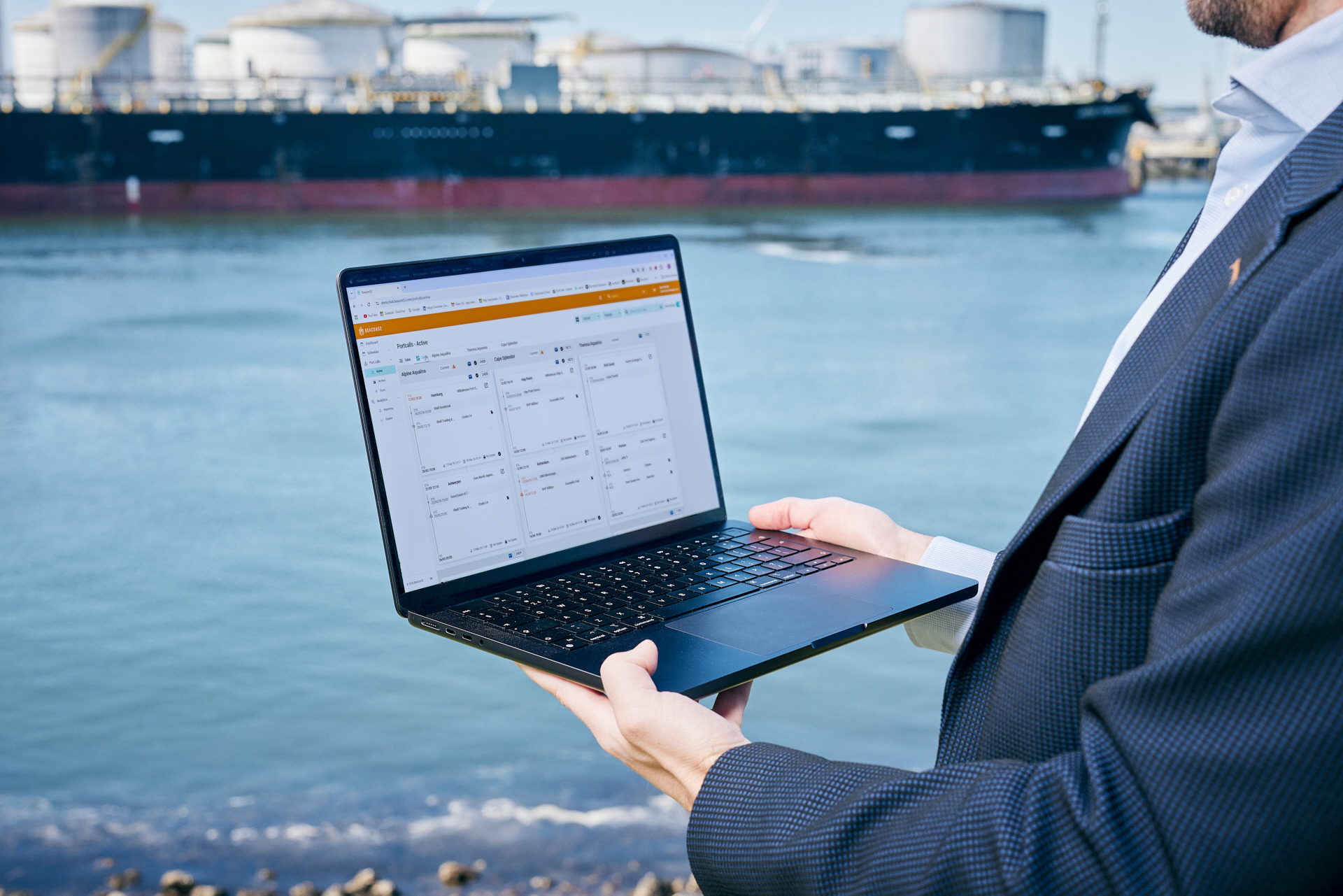
Rather than relying on fragmented communication, they are introducing digital workflows that connect vessels, agents, terminals and office teams within a single operational environment. By integrating operational updates with financial oversight, these systems provide a shared and reliable view of events across each port call.
This shift is less about automation than about visibility. When information flows through a structured system rather than scattered communication channels, teams gain a clearer understanding of what is happening across their operations.
Issues can be identified earlier. Decisions can be made faster. Administrative workload can be reduced while financial oversight improves.
Shipping will always involve complexity. Ports operate under different regulations, infrastructures and local practices, and global supply chains will never be entirely predictable.
But complexity does not necessarily require chaos.
The companies that succeed in introducing structure and transparency into their port call processes gain a powerful operational advantage: the ability to manage fleets with greater clarity, stronger financial control and far greater confidence in the decisions they make.